Back in September I wrote about Google Reader as a good way to begin reading blogs and building your Personal Learning Network. If you followed my advice, then you have probably seen in the last few weeks that Google has decided to pull the plug on Reader, for reasons that to me are less than clear. Despite the Twitter protests (use hashtag #savegooglereader), Google does not seem amenable to changing their plans.
I've been looking into alternative RSS readers and my favorite so far is Feedly. It will read your Google Reader subscriptions, so if you have a lot of blogs you read, importing is very easy. Feedly has a nice, magazine-style look; it reminds me of Zite, my favorite magazine app which is unfortunately not available for Android tablets, only phones. It took me a while to get used to the interface, but that would be true for any new software.
If you're looking to start using an RSS reader now, or need to migrate from Google Reader to something else, take a look at Feedly.
Showing posts with label RSS. Show all posts
Showing posts with label RSS. Show all posts
Monday, April 8, 2013
Monday, October 22, 2012
Personal Learning Networks - Book Review
They define a personal learning network as a "set of connections to people and resources both offline and online who enrich our learning." (page 2). While these have existed throughout history, the emergence and proliferation of electronic connections makes global networks possible and even easy. For students, this can shift the locus of learning outside of the classroom. Why should they listen to their physics teacher, when they can connect with physics experts throughout the world?
[T]he explosion of learning outside of school walls is too powerful to ignore.... [T]he idea of schooling as we currently know it will struggle to remain relevant in a networked world.... [S]chools need to plug into this vibrant worldwide network of learning to stay relevant and to prepare our children for a vastly different learning landscape. That means schools will need to embrace a form of learning that is fundamentally different from the one they have known. (page 3)The authors then develop their argument that personal learning networks are the key to this transition. They describe the positive effects of PLNs, how to become a networked learner, how to implement a networked classroom, and how to become a networked school. It is the first part of the book that I found most useful and that I suspect most teachers will as well. Understanding why and how to develop PLNs are the first steps toward helping students use them effectively.
Chapter 2 (Becoming a Networked Learner) includes instructions for joining Twitter, Diigo, Google Reader, Blogger, and Facebook. Each of these sections describes the tool, some of the advantages and disadvantages of it, and how to jump right in and start. I currently use all of these except Facebook for professional learning, and feel like they have certainly helped me make my transition from science teacher to educational technology teacher. These kind of connections can help any teacher, but are especially relevant for the isolated teacher: someone who doesn't have any colleagues teaching the same class at their own site.
The companion website has links to the resources listed in the book. I highly recommend this book (especially the first half) to anyone still wondering how technological development is affecting learning processes. If any of you would like to borrow this thin volume, please let me know.

Monday, September 3, 2012
Use an RSS Reader to Help Build Your PLN
One of the best ways for you to add to your personal learning network (PLN) is by reading blogs (like this one). To make this easier and more convenient, there are RSS Readers like Google Reader. An RSS reader allows you to subscribe to a blog or website and be notified whenever something new is posted. That way you don't have to go searching 20 different websites every day just to check if there's a new article.
 To start with Google Reader, click on "More" in your black bar at the top of the screen when you're in Gmail or you Calendar. A menu will appear, and you should select "Reader". Then you'll want to find sites to which you want to subscribe. Any blog (or other site) that has this icon has an RSS feed and you can subscribe to it, usually by clicking on the icon. For this blog, the RSS icon is the bottom one on the black bar on the right of the screen.
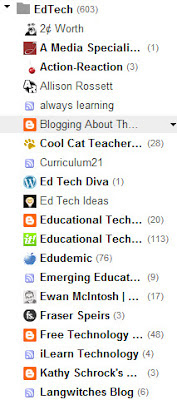 When you subscribe to a blog by RSS, Google Reader shows a list of your subscriptions on the left-hand side of the page. (The list here shows some of the educational technology blogs to which I subscribe.) Blogs that are listed in bold have new items that I haven't read yet; the number in parentheses tells me how many unread items. Most items you can read from within Google Reader, without having to go to the actual website itself; sometimes, though, formatting gets mixed up. You can always go to the actual post by clicking on the title in Google Reader.
Blogs and Twitter are two very useful ways to build your PLN. The more you read and comment, the more ideas you get, and the more effective of a teacher you become! Give it a try!
To start with Google Reader, click on "More" in your black bar at the top of the screen when you're in Gmail or you Calendar. A menu will appear, and you should select "Reader". Then you'll want to find sites to which you want to subscribe. Any blog (or other site) that has this icon has an RSS feed and you can subscribe to it, usually by clicking on the icon. For this blog, the RSS icon is the bottom one on the black bar on the right of the screen.
Blogs and Twitter are two very useful ways to build your PLN. The more you read and comment, the more ideas you get, and the more effective of a teacher you become! Give it a try!
Subscribe to:
Posts (Atom)