Showing posts with label smartphones. Show all posts

Sunday, September 6, 2015

On Cell Phones in Classrooms

Poster currently in several classrooms in my district
In the spring, I held an after-school workshop titled "Classroom Management in the Age of BYOD". My intent was for teachers to discuss and share some ideas about successful management strategies in classes where students are using their own cell phones, tablets, or laptops on a regular basis. The workshop went in an unexpected (to me) direction when it became apparent that most of the teachers there were more interested in learning how to ban cell phones and prevent their students from using them. We had suggestions ranging from "collect them at the door" to "email all parents asking them to keep the devices at home" to "remove the wi-fi from all classrooms in the district". I left discouraged.

I once had a ban on cell phones in my classroom. I had a poster similar to the one shown here. That was about 15 years ago, when phones were simply phones, and their use in public places was a novelty. Every few days, one of my students' phones would ring during class, because they weren't used to silencing them. Most of the students' phones resembled the cartoons in this poster. I had to teach them about appropriate and inappropriate times to have their phones' ringers on.

Photo by Flikr user "Images Money", CC-BY 2.0
Do I have to state the obvious? What (most) students carry around in their pockets has as much resemblance to a cell phone from the early 2000's as my laptop computer does with a bakelite rotary dial phone. Most people, including students, are accustomed to silencing ringers and notifications at the appropriate times. What they are not necessarily used to, however, is using their powerful pocket computers for learning and research in addition to socializing and games. This is because we haven't taught them how to do that. And we can't teach them how to use their phones for productive work if we confiscate them on entrance or on sight.

Which brings us to the recurrent hand-wringing article or blog post like this one from Edutopia in June. For all the concern about teachers being "tired of seeing students text each other" and "text language and spelling that creeps into student assignments", there is precious little in this article actually concerned with student learning. The author writes about "the best thing you could do for yourself", "you have to enforce it", "[e]very teacher's tolerance... varies". The closest the author gets to addressing instruction and student learning is a throw-away line:
Perhaps the most important element is minimal downtime in your learning activities, because the temptation to sneak a look is just too strong. 
The comments on the article continue in a similar vein: students are just too distracted by their phones, and need to focus and concentrate on what the teacher is presenting. This is decidedly not a student-centered mindset.

Fortunately, there are educators who recognize that these pocket computers (a) are not going away any time soon, (b) are only going to get more powerful, useful, and widespread, and (c) will be a crucial part of our students' jobs and lives, even more than they are today. Exhibit A, from 2010 (!) by Doug Johnson in ISTE's Learning and Leading with Technology. (Thanks to Chris Ratican on Twitter for the link.) Exhibit B, from Katie Martin, Director of Professional Learning at the University of San Diego. Exhibit C, from Lisa Nielsen, in Tech & Learning.

We cannot simply pretend that powerful pocket computers don't exist or are not going to be important to our students in their futures. We have to teach students how to use them for productive learning. Doing otherwise, in 2015, is educational malpractice.


UPDATE: As if on cue, here's this article from CBCNews: "Smartphones in the classroom: a teacher's dream or nightmare?" It's actually a fairly reasonable article except for this key quote:
But what about the distraction? Surely kids with a cellphone or tablet in front of them will stop focusing on a lecture and start Facebooking or online chatting?
As they should! Just as adults do in a meeting during a boring, irrelevant lecture or presentation. Our teaching methods and strategies have got to match up with students' needs. If you're trying to lecture to high school students, don't be surprised to see them tune you out, whether it's with their phone or by doodling or just by daydreaming.

ANOTHER UPDATE 12/6/2015: Here's another one, from NPR in November: How to Get Students to Stop Using Their Cell Phones in Class. As Julie Smith (@julnilsmith) points out on Twitter, the comments are terrifying. There is one comment I like, however, from user616828: "The 1950s called, they want their pedagogy back."

Friday, September 19, 2014

Teens, Tech, and Trends

Adrienne St. George is our district's Media Center Specialist. She contributes this guest post on teens and technology. You can contact her at adrienne.stgeorge@sduhsd.net.


Technology is NOT going away! That’s not a news flash, is it? The real news is that as the use and acceptance of technology expands, so do the skills of the users, especially those in the 16 – 29 age groups.

Recent reports from PEW, Common Sense Media, and other research centers, show that the use of technology as a whole is increasing dramatically from ages 0 – 60+ with very encouraging trends. The surges of use and skill vary for different age groups and for different end goals.

With the focus on teens and young adults, the research results are amazing. Referred to as millennials, access to media devices for this group has exploded in the past 2 - 3 years. Usage of media devices has more than doubled in that time. Average time of use on a device has tripled in that same time frame. Traditional screen media such as TV, DVD, video games has decreased significantly. TV is still a dominant venue but is now viewed through a DVR, is streamed or viewed from “on demand”. Access to devices is becoming more equitable to all socioeconomic groups. Smartphones are the devices that are used the most.

Why a mobile device? Why a smart phone? Reasons given to researchers:
  • Always with us 
  • Instant information and accessibility anytime/anywhere 
  • Fingertip action 
  • Timely info 
  • Location sensitive 
  • Instant feedback 
  • Ability to create our own info and share 
Summary of research:

Teens live in a different information ecosystem:
“There is no playbook for this new environment” (13 Things to know about Teens and Technology, Pew Project, July 23, 2014.) Teens are not aliens but they are different because they are tied to technology. Technology saturates their lives. Teens are becoming a network of information. Information is another skin…natural, ubiquitous, portable, immediate, timeless, participatory, connected and social. More than 95% of all surveyed have broadband at home, more than 70% have access to the Internet on a mobile device, 78% at least have a cell phone (close to 50% have smartphones), 81% use social networking. End result: data and info is a third skin…it is just normal.

Teens live in a different learning ecosystem:
The surveyed College Board and NWP teachers agreed that although technologies are creating a somewhat distracted generation, the internet and digital tools have had a very positive impact on student research. These same teachers strongly believe that the Internet gives students a much wider range of resources than traditional resources. Students know how to access the Internet, use search engines and find information easily. They all agree that while students are very self-sufficient researchers, they believe that a lot of the information found is overwhelming and difficult for students to understand. However, they believe that this is a common problem with traditional research as well. Their main concern for students is the inability to discern bias and validity. Traditional resources were usually considered “pre-validated”. Now students must learn how to validate sources themselves. This is where teachers come in. The surveyed teachers strongly believe that digital literacy needs to be incorporated in daily lesson plans. These teachers stated that exposing students to and teaching them how to use digital resources other than the top three used (Google, Wikipedia and YouTube) would expand research skills, learning and knowledge to even higher levels.

Learning should be a process, rather than an assignment. Teens/young adults create knowledge, rather than receive knowledge. Knowledge is interactive, rather than transmitted in static structures. Learning is active with the learner managing his/her own learning process, rather than passive with the learner just listening and watching.

Overall consensus:
Teens/young adults are wired differently and lead very functional hyper-connected lives. Teens are able to handle multitasking seamlessly. Adults claim multitasking skills, yet they are aware of the different tasks they try to accomplish simultaneously, while it is effortlessly integrated in millennials. Multitasking for adults is clunky and obvious; multitasking for the under 30 age group, is fluid and natural.

The majority of survey participants strongly predict that the future, as soon as 2020, is positive for millennials. Millennials will be able to problem solve quickly and efficiently through cooperative work; they will be able to effectively search for information online, discern the quality and veracity, then communicate the findings; they will be able to synthesize and collect details from many sources into a final suggestion/solution; they will have the ability to distinguish between “noise” and the real information in forever growing amounts of data.

I've always been fascinated by what teens/young adults are capable of doing with phones, with tablets, with all of their devices for school and for fun. Teens today are bright and savvy; they want to be challenged. They want to try to do everything on their devices especially if people tell them it is not possible. It is so nice to hear clear optimism from so many reliable sources that teens really are capable of using technology successfully for learning and probably in ways adults never imagined.


More Teens Use Smart Phones to get Online, eSchool News, 3, 2013
Zero to Eight, Children’s Media Use in America 2013, Common Sense Media Research

Pew Reports:
5 Media Spaces Where People Live
Digital Age Reading, Writing, Research
Teens and Libraries in Today’s Digital World
13 Things to Know about Teens and Technology
Teens and Technology 2013


Thursday, March 7, 2013

Language Shapes the Way We Think

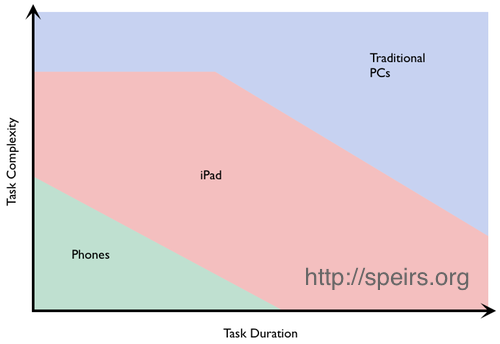
Fraser Speirs has developed a nice framework to use in thinking about what type of device is the best for a particular task.  While the traditional dichotomy is one-dimensional (consuming information vs creating information), Speirs proposes that we think about a two-axis chart, with task complexity on one axis and task duration on the other.

While I think this is a useful way to think about "the right device for the task", I have one major issue with this diagram.  Why is the middle zone labeled "iPad" rather than "tablet"?  The lower one is not labeled "iPhones".  The upper one is not labeled "iMacs".  The use of "iPad" as a generic name for a tablet device is (a) a triumph of Apple's marketing and (b) a hurdle for our district to overcome.  As we investigate the best devices for district technology to purchase for teachers and students, more and more we come to Chromebooks and Android tablets, only to hear from teachers that they want "iPads".  Some teachers can give very good justifications for why they want an iPad specifically; others are simply using the term as a shortcut for "tablet".  Diagrams like the one above contribute to the confusion.

I'm not trying to disparage iPads in any way.  I've just never had anyone be able to explain to me why a tablet from Apple is a better educational device in all situations than a tablet from Samsung, for example.