Showing posts with label Twitter. Show all posts

Saturday, February 6, 2016

#SDUHSDchat February 9-15: Slooooooow Chat

Instead of our traditional Tuesday night 8:00 - 8:30 "blink and you'll miss it" #SDUHSDchat, let's try something different this week. For the week of the 9th through the 15th, we're going to do a "slow chat". One question will be posted each morning at 7:00 am. You can participate in the chat at any time you like, however frequently or infrequently you choose. Just be sure to include the hashtag #SDUHSDchat in your responses and discussion.

If you are using the standard Twitter website, you can always click on the hashtag to get a timeline that only includes #SDUHSDchat. If you are using Tweetdeck, you can create a separate column for our chat. Or you can use the Participate Learning interface, which is getting better and better for managing Twitter chats.

I will update this post with the questions for each day, so you can always refer back to this post if you miss the day's question in the morning. Questions will be coming from the @SDUHSDchat account as well as from my account, @kfairchild6.


Q1 - Tuesday the 9th
What are some things in your life that happen too quickly? What do you do to make them slow down? Why?

Q2 - Wednesday the 10th
What are some things in your class that happen too fast? What makes you think so? How could they slow down?

Q3 - Thursday the 11th
Team Hare or Team Tortoise? Slow and steady or quick as a jackrabbit? Which is the way you typically work? Why?

Q4 - Friday the 12th
Think about a student’s typical school day. In what ways are they too rushed? How can Ts help them slow down?

Q5 - Saturday the 13th
Often, being “busy” is seen as being successful. Do you agree? Are your weekends busier than your work week?

Q6 - Sunday the 14th
Is the old adage of “Sunday is a day of rest” outdated? How do you rest and recharge over the weekend?

Q7 - Monday the 15th
4th day of a long weekend! Did your Ss relax at all, or are our Ss' lives overscheduled? How can Ts help?


UPDATE: I should have mentioned in the first place that my own introduction to "slow chats" was from the inestimable David Theriault (@davidtedu) in this blog post from January 2014. He tells me he had never heard of a slow chat before that, so lacking evidence to the contrary, we're going to give David the credit for this idea!

Saturday, September 12, 2015

You Might be a Twitter Bot if...

1. Your username has a random string of numbers at the end, that humans would be unlikely to remember.

2. Your profile description is a list of general descriptions with no specific information or location. (And stars in between phrases; what's that all about?)

3. Your profile description is supposed to be "whimsical" but actually sounds like it was written by a machine who had heard of humans but never actually met one. ("Award-winning" what, Jennifer? "Recovering youth worker"? Ew.)

4. Your profile picture is a stock photo found on the web and multiple other Twitter accounts. (Do a Google Image search to check this.)


5. Your tweets are a series of random, non-sensical phrases or ads.


6. Nobody is starring, retweeting, or replying to your tweets.

7. Your tweets can be found verbatim in Wikipedia or dozens of other tweets, but none are re-tweets or replies. (To check this, copy the text of the tweet and paste it in to a Google search. Put quotes around it, to search for the entire phrase verbatim, then click "Search".)


Addendum: What can you do if you are followed by a Twitter Bot? Please report them for spam and do not follow back. It's a small thing to do, but if enough of us do it, we may have an impact.

P.S. This is just the most recent manifestation of Twitter Bots. Click here to read about a previous one.

P.P.S Got another Bot follower literally while I was writing this post:


Saturday, May 30, 2015

How Do I Get A Job Like This?

In September, I wrote a post about lazy editorial cartoonists, which included this image from Rick McKee of the Augusta Chronicle from August of 2014:

Earlier today, I saw this image reposted on a blog:

Wow, that seems familiar. I wonder who drew this one? Oh, look, it's Rick McKee of the Augusta Chronicle in August of 2013. (That teacher has gained some weight over the year. She might want to see a cartoon doctor. Probably one wearing an old-fashioned circular reflector on his head.)

I'm going to gloss over the relative popularity of Facebook and Twitter with school-age children (spoiler alert: it's zero), although I will note that I look forward to McKee's cartoon from August of 2015 where the child shows the dowdy teacher his MySpace page.

I just want to know where I can get a job where you can do the same thing year after year, pulling out your old work, maybe changing a bit here and there, and then submit it to your audience as if it were brand-new. Does anyone know of any profession other than editorial cartoonist where that is acceptable? If I tried to do that as a teacher, I'd... wait a sec...

Oh.....

Thursday, February 26, 2015

How SDUHSD Learned to Twitter Chat

I've said it before and I'll say it again: If you're not reading Bjorn Paige's blog (bjornpaige.wordpress.com), you are missing some fantastic writing and reflection on education in general and middle school in particular. In January, he announced the second installment of the Diegueño book club for parents and staff, focused on Daniel Wolff's How Lincoln Learned to Read: Twelve Great Americans and the Educations that Made Them. (Amazon link)

Since the book club meeting is scheduled for a Tuesday evening, Bjorn and I decided to also use this book as the topic for our weekly district Twitter chat, On March 10, #SDUHSDchat will be at a special time and will focus on several issues raised in different chapters of the book.

Wolff's book is a collection of 12 more-or-less independent chapters, each describing the education of a famous American and how that education both reflects the ideas of the times and shapes the lives of the people who experience it. Bjorn is planning his own questions for the in-person book club; for our Twitter chat, aimed at people who may or may not have already read the book, each of our discussion questions will be based on a short excerpt from a chapter. If you have the time to read the book beforehand, that would be great; if you don't, you'll still be perfectly able to participate in the chat.

I will be moderating the chat from the book club in-person meeting, at the Diegueño Media Center, from 5:00 to 6:00 on Tuesday the 10th. We will be displaying the chat on a screen in the Media Center, for in-person participants who might be interested. I'm also hoping to be able to bring some of the book club discussion to the Twitter chat as well.

This is an experiment on our part. I've never live-tweeted a book club discussion before, nor have we done a hybrid Twitter/in-person conversation like this. I'm hoping that the combination of the two discussions will produce something greater than the sum of the parts.


Saturday, January 24, 2015

On Chatting, Proximity, and the Advantages of Pizza

Over the last several months, many districts in San Diego County have started regular Twitter chats. Inspired by them, and frustrated with my inability to keep up with huge fast-paced chats like California EdChat (#CAedchat), I gathered four other SDUHSD tweeters in May and we started #SDUHSDchat, on Tuesday nights from 8:00 to 8:30 Pacific Time.

Over the course of the year, we've had some well-attended chats and some not-so-well-attended. No matter who is there, the chat is entertaining and interesting (at least to me), but it seemed that we had a drop-off in participation in November and December. This is perhaps to be expected, as teachers were busy with holiday activities, and our chat schedule was irregular to say the least during that time. So I wanted to do something to increase interest and participation.

I had already had the idea of doing an in-person chat, with teachers who were unfamiliar with Twitter or with chats sitting in the room with Twitter veterans who could look over their shoulders and help them out in person. Then I saw that the Santee school district had done just that, but at a restaurant, as a social activity! The light bulb went on! #PizzaChat was born, at least in my head. (Thanks to Kristen Eveland, @keveland2, for the inspiration!)

Administrators as well as teachers came out to learn!

We would do our first #SDUHSDchat of 2015 as a #PizzaChat, using the promise of free food and free help to attract teachers! The next steps were to choose a time and a location. If we used an off-campus restaurant, the event would be more social and teachers could indulge in adult beverages. If we used a location at one of our school sites, we would have better computer and wi-fi access, and we wouldn't need any reservations or agreements with a restaurant. Holding the chat in mid-afternoon, right after school would be more convenient and would probably get better attendance; having it later (like 5:00 or 6:00) would be closer to dinner time and take better advantage of pizza. (Who wants a pizza dinner at 3:30?) In the end, we decided on earlier and on-site, and that turned out to be exactly the right decision.
SDUHSD teachers learn (or re-learn) using Twitter for professional connections.

As it happened, we ended up with about 15 teachers either brand-new to Twitter or who had signed up but never used their account. The conference room we chose was crowded, which was exactly what I was hoping for. (Others had suggested moving to the media center, but I thought that I'd much rather have a crowded small room than a relatively empty larger room.)
We had a chat with questions that were relatively silly, because the questions were not the point of this particular chat. The point was getting teachers familiar with the idea and the mechanics of building their PLNs.

OK, so we proved that we could draw people to our Twitter chat if we fed them pizza. The real test, however, would be the next week. How many of these teachers would return to our Tuesday night chat if it was, as I put it, "BYOP (Bring Your Own Pizza)"? The answer was gratifying. Our chat on the following Tuesday was better attended than almost any of our previous chats.

What were my take-away lessons from this?
Who knew chatting was such serious business?

  1. Twitter chats don't have to be serious, high-minded, or deeply philosophical. My questions were silly, but slightly thought-provoking. I was inspired by #WeirdEd chat, started and moderated, appropriately enough, by @TheWeirdTeacher.
  2. Proximity means a lot. Being physically present in the room, and able to answer teachers' questions by looking over their shoulder and pointing at the screen, is for many teachers a thousand times more effective than any explanation by email or phone or social media.
  3. Teachers will come out for pizza. Doesn't matter what else is happening.
  4. Once we get teachers started on Twitter, they recognize what a valuable resource it is, chats or no. I commented to my officemates that I thought it was cool that part of my job was to eat pizza and tweet, but it's not as trivial as it sounds. One of my goals this year is to help teachers build their PLNs, and using Twitter is the single best way I have found to do that.
Special thanks to Bjorn Paige (@bjornpaige) for the use of the Diegueno conference room and the photos in this post. Also thanks to Lori Meyer (@meyerteacher), Mark Van Over (@APMarkVanOver), and Michelle Anderson (@mathmama) for helping moderate #SDUHSDchat. Look for us on Tuesday nights at 8:00 PT!


Monday, September 1, 2014

Of Poor Cartooning, Obvious Jokes, and Back-to-School Assignments

Joe Heller, Green Bay Press-Gazette, 2009
Jeff Parker, Fort Myers News-Press, 2012
Rick McKee, The Augusta Chronicle, 2014
And these are just the ones I found with a few minutes of googling. OK, we know that there are only a few editorial cartoons in existence, that get rehashed over and over. (Surely there's an "Editorial Cartoon Tropes" website, like "TV Tropes", but I'm not going to search for it because I might find it.) And, yes, I get that single-panel cartoons have to include signifiers like the apple on the desk, old-school (literally) chalkboard, and ruler in the school-marmish teacher's hand, so that (older?) readers know the scene is set in a classroom. And I understand that part of the "humor" in these is the contrast between the "old" teachers and the "young" students these days with their phones and their technology and their twittagramsnapbookchatspaces and whatnot. But really? Do we have to do this same "joke" over and over again? (With a little bit more searching, I bet you could find the same cartoon for 2010, and 2011, and 2013. I'll actually give Joe Heller a little credit: in 2009, Twitter was not nearly the big deal and obvious cultural reference it became later.)

You know what would be a great assignment for the first week of school? Having students share what they posted on Twitter during the summer. Or on Instagram. Or have them create a Glogster of their photos and texts and tweets. Or contribute to a class blog about their experiences. Or compiling their Vines into an annotated YouTube video.

You know what would not be a great assignment for the first week of school, and would only indicate that you are out of touch with modern schools, children, technology, and culture in general, and that you can only imagine a school system that looks exactly like it did when you went to school decades ago? Asking students to put down their devices, ignore the writing and reflection they did during summer when school is out, have them get out a nice, sharp #2 pencil, and handwrite (maybe in cursive) a boilerplate 3-paragraph essay about "What I Did This Summer".

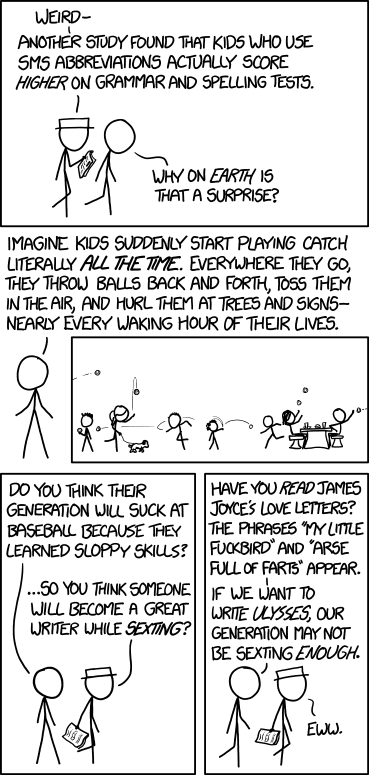
"But," you might object, "kids didn't do real writing during the summer. Texting and tweeting and tumblring aren't valuable as academic writing." Maybe not. But they were doing it. They were communicating with each other. Writing practice is writing practice. The inestimable Randall Munroe of XKCD, as usual, has said it better than most:


Saturday, August 9, 2014

What I Did on My Summer Vacation

End of June - ISTE Annual Conference - Atlanta, Georgia
My first trip of the summer started about a week after I had finished the school year. For the third year in a row, I was able to attend the huge annual conference put on by the International Society for Technology in Education (ISTE). In 2012, the conference was in San Diego; in 2013, I traveled to San Antonio. This year I flew to Atlanta for this enormous ed-tech affair.

The size of this conference is both a blessing and a curse. Because of the number of attendees, ISTE can attract some of the best keynote speakers, the best presenters, and a vast array of vendors for the exhibit hall. On the other hand, nearly every major session is crowded, overflowing, or with a huge line to get in. I had more than one instance in which I went to attend a session, saw the line of people waiting to get in, and just turned around and walked away. The crowds got frustrating after a while.

The best formal session I attended was a talk by Dr. Ruben Puentadura, creator of the SAMR model for instructional technology integration. He gave a great description of the connections between the TPACK model and his SAMR model, showing the overlap and similarities. It really helped me with a better understand of TPACK. (I've written before about my preference for SAMR over TPACK when working with teachers.)

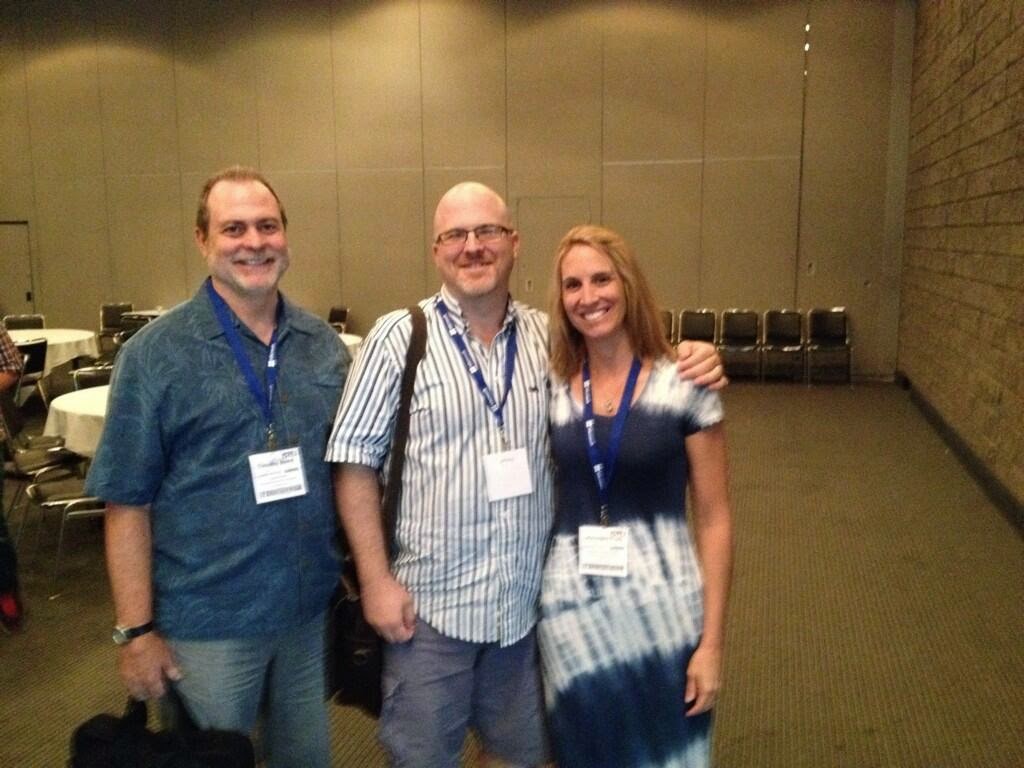
With Tim Baird and Leighangela Brady of Encinitas USD
The exhibit hall for ISTE is always massive; too much to take in for any one person. At other conferences, I set aside time to just wander up and down the aisles, seeing what companies are there and what they might be able to offer us. There is no way you could accomplish this at ISTE. What I did instead was go through the program and pick out eight or ten vendors I wanted to talk to, then targeted those booths. Even so, that ended up taking me the better part of an afternoon, and I was exhausted from walking back and forth across the cavernous exhibit hall.

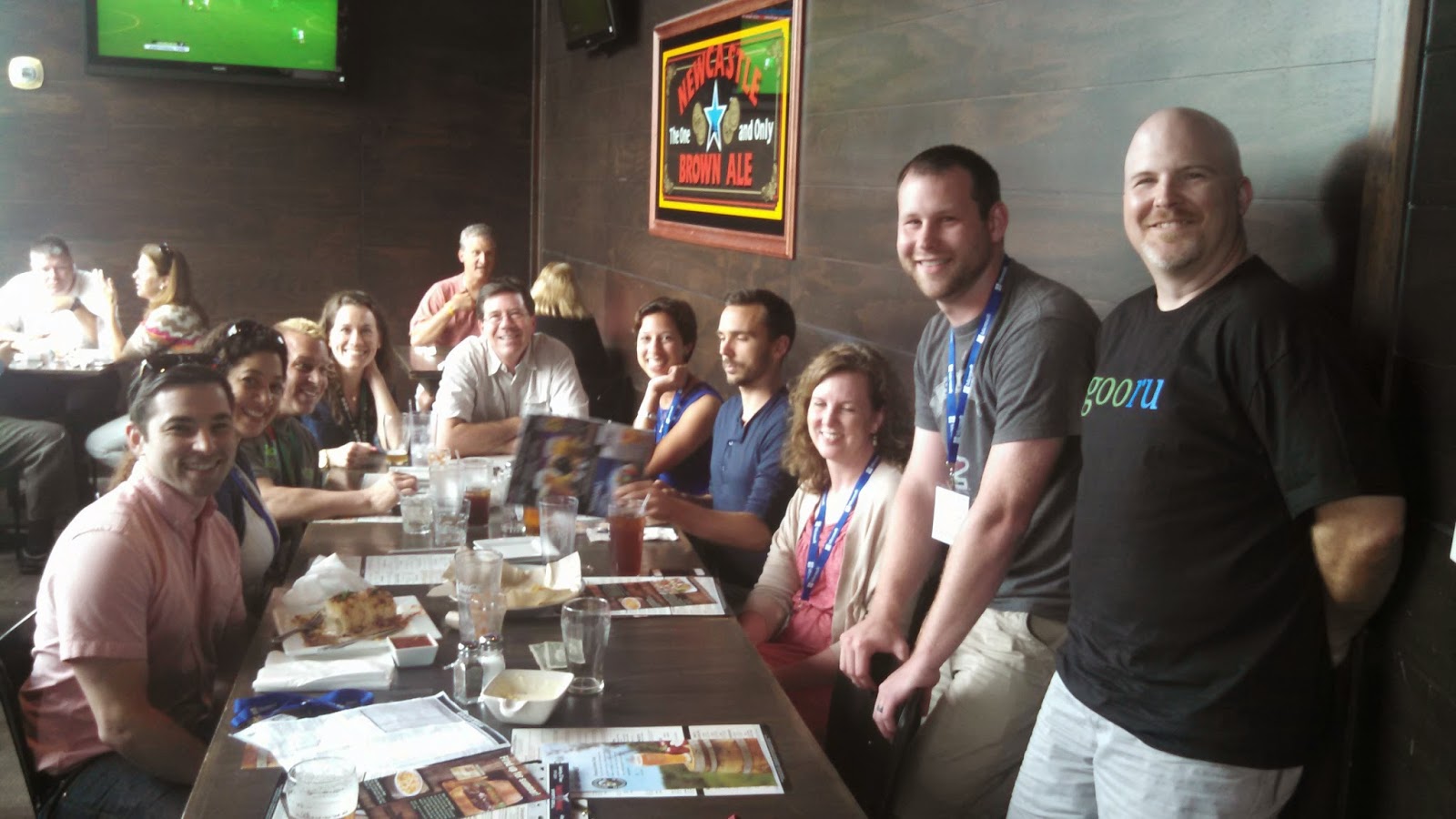
Despite the size of the crowd, I did manage to meet up with people I knew, thanks to social media. The night I got in to Atlanta, I met up with a group of teachers, many from California, at a German-style beer garden for a "#brewCUE". I arranged to meet up with Dr. Brady and Tim Baird from Encinitas; we talked after a session on effective PD for teachers. Mike Guerena from Encinitas was on my flight from San Diego; I only found out after tweeting about the flight delays. I had lunch with Torrey Trust, my former student at La Costa Canyon and newly minted Ph.D. from UC Santa Barbara. Her talk on how teachers used social media was enlightening and exactly in line with other research presented at the conference.

Future Google Certified Teachers meeting for the first time

I also met up with a few of the teachers who would be attending Google Teacher Academy with me at the end of July (see below).

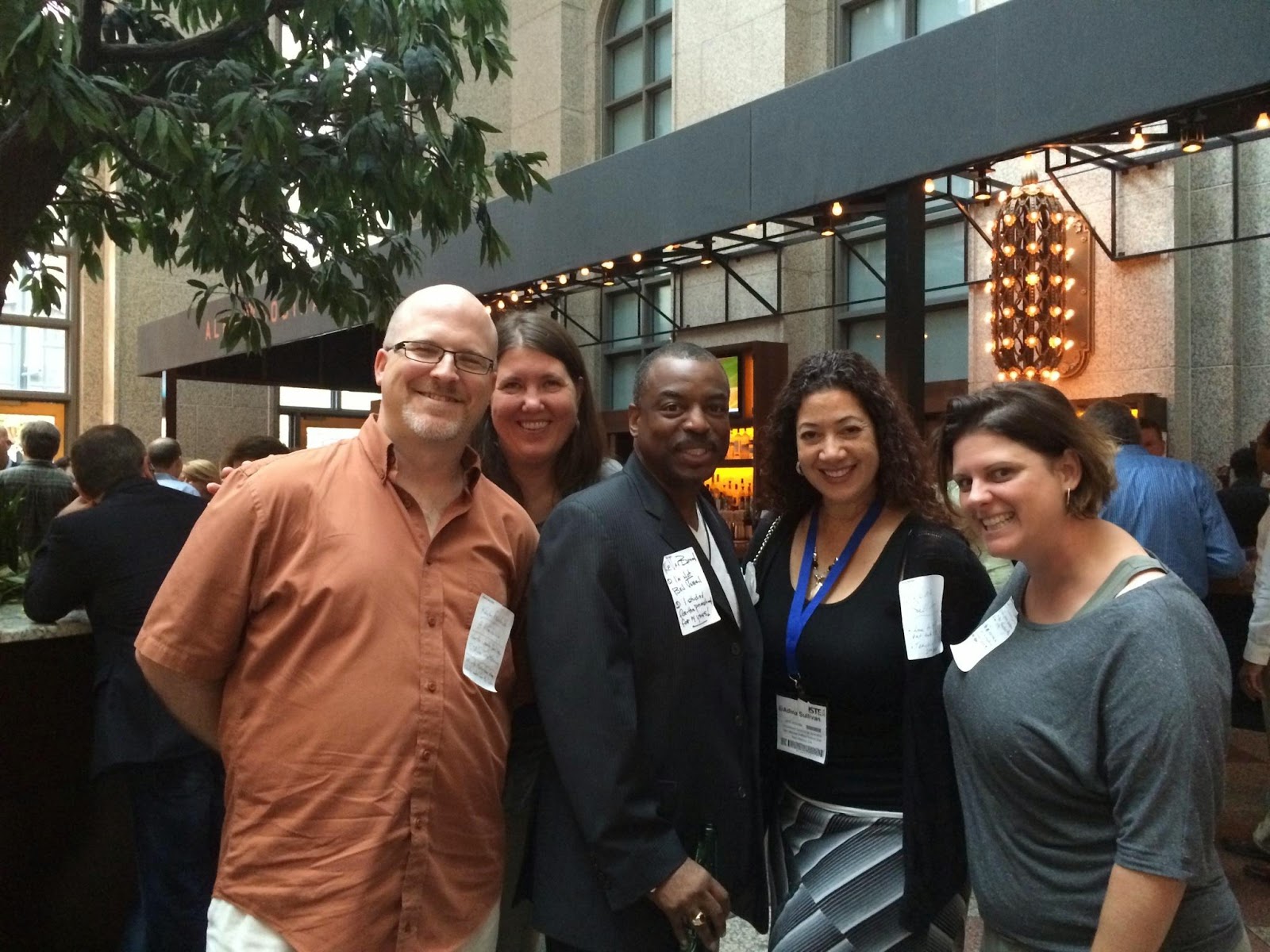
Oh right, I also got to meet Levar Burton, fresh off his
Reading Rainbow App kickstarter success.


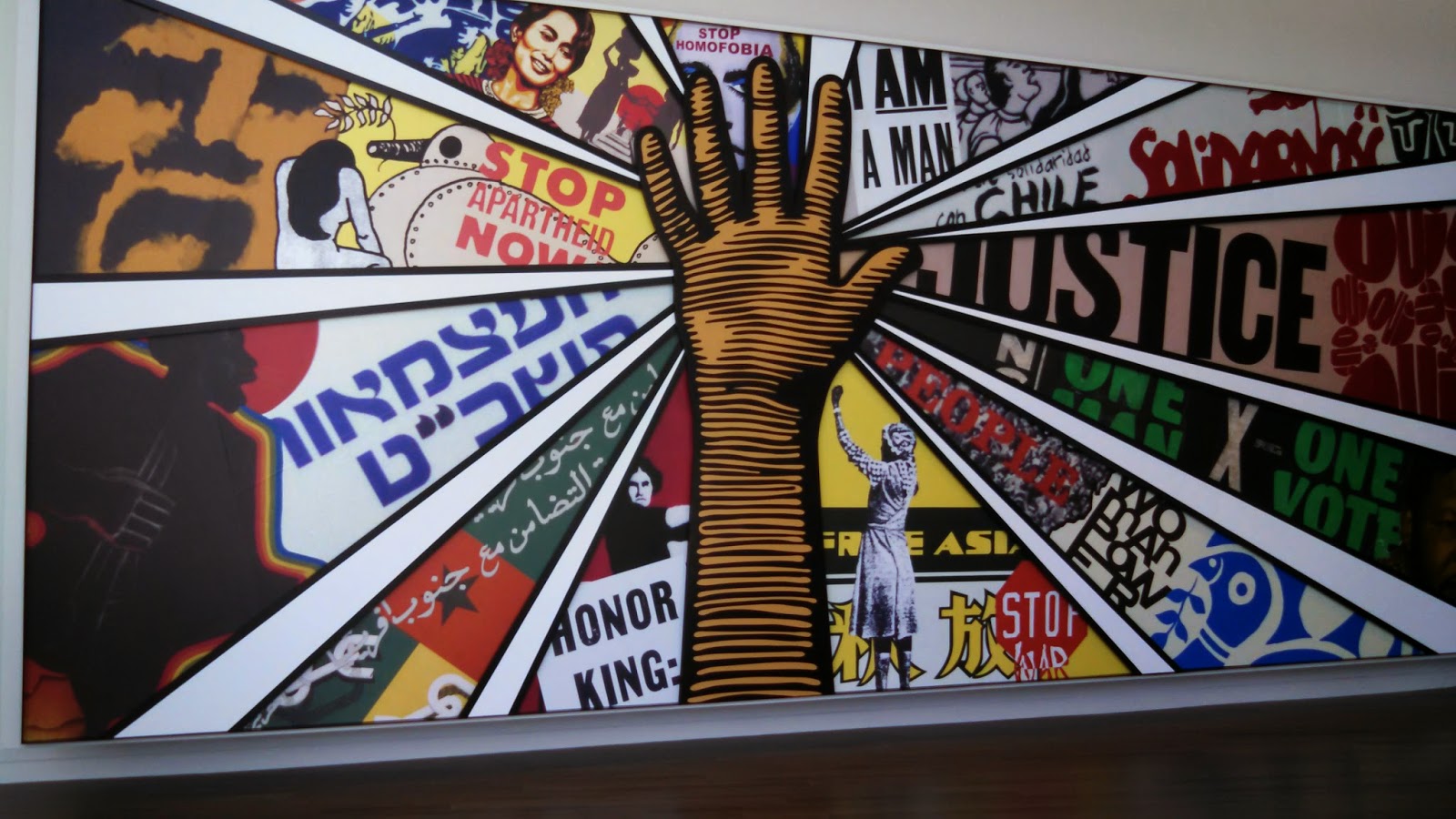
Perhaps the most affecting part of the trip was my visit to the National Center for Civil and Human Rights. I had a free afternoon, so I visited this museum, most of which is dedicated to the Civil Rights movement in the early 1960's in the South, especially Atlanta. I found it an extremely emotional experience. I am a history buff and have a good understanding of the events of the 60's, but going through the well-designed exhibits brought home the personal costs to people of that era. I found myself furious that these things had happened in my country, and wondering to myself, "If I am so emotionally affected by this, what can it possibly be like for the black parents and children who are walking through here with me?" If you're ever in Atlanta, this museum is a must-see.
Mural at the National Center for Civil and Human Rights.
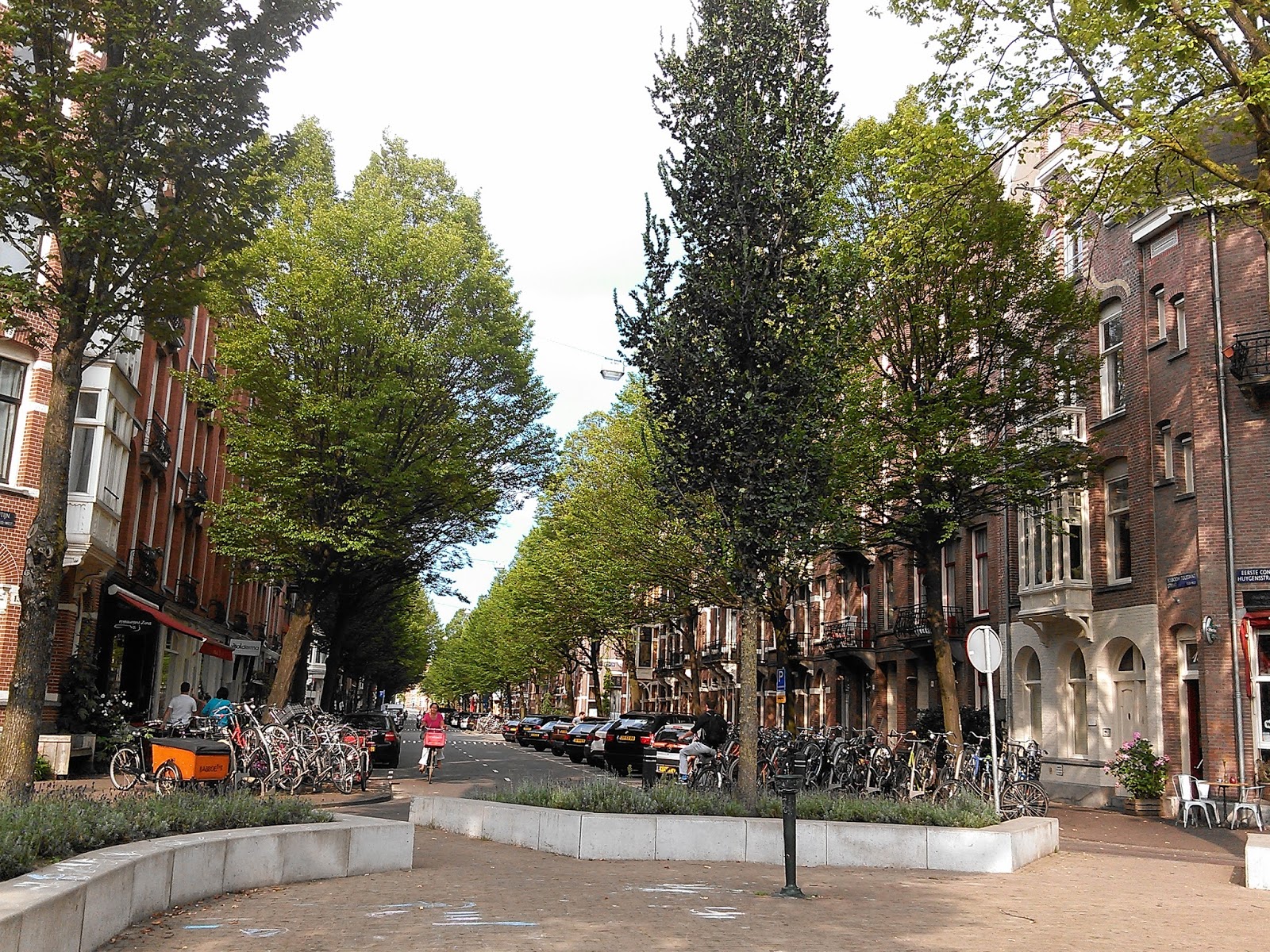
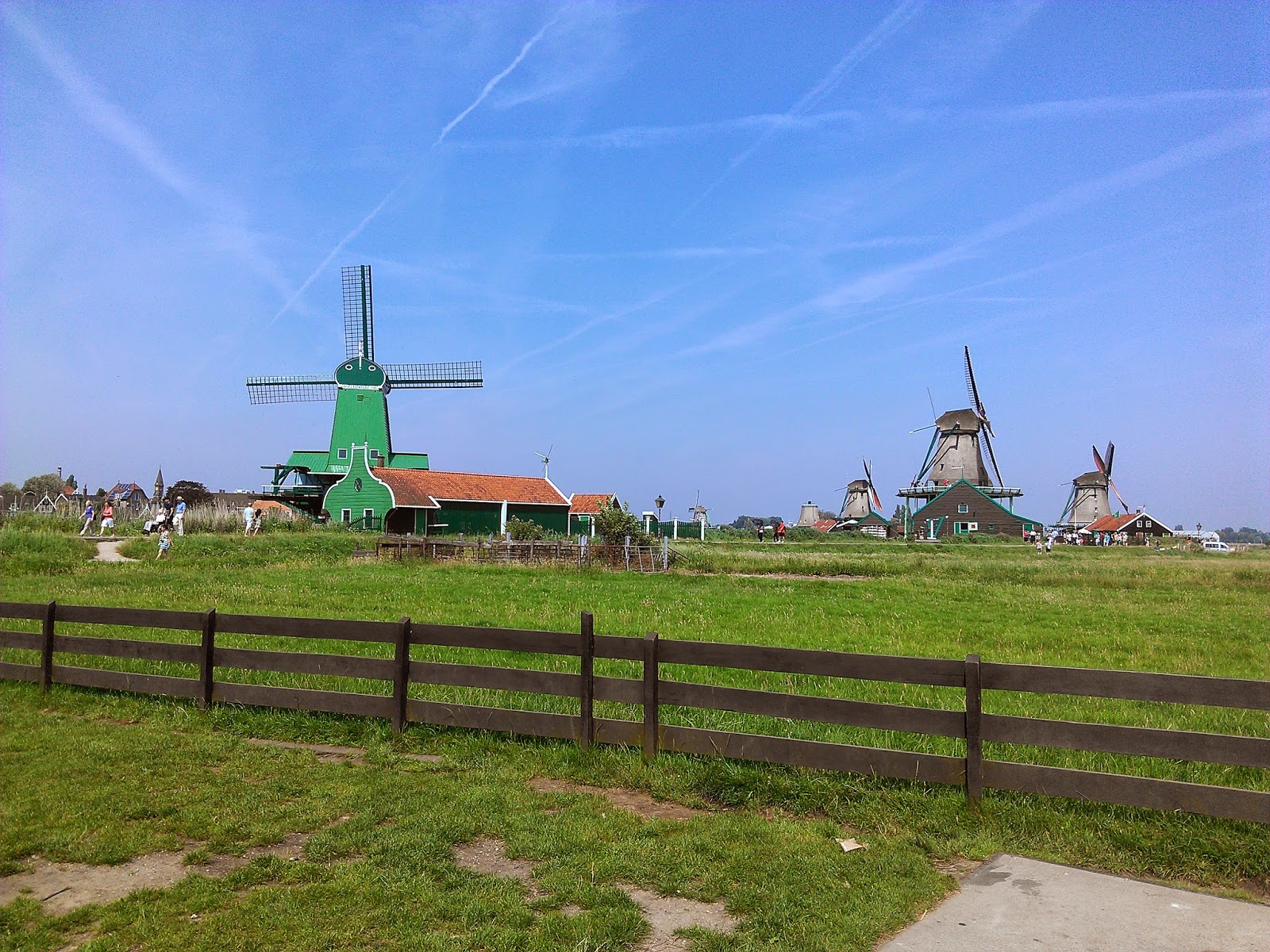
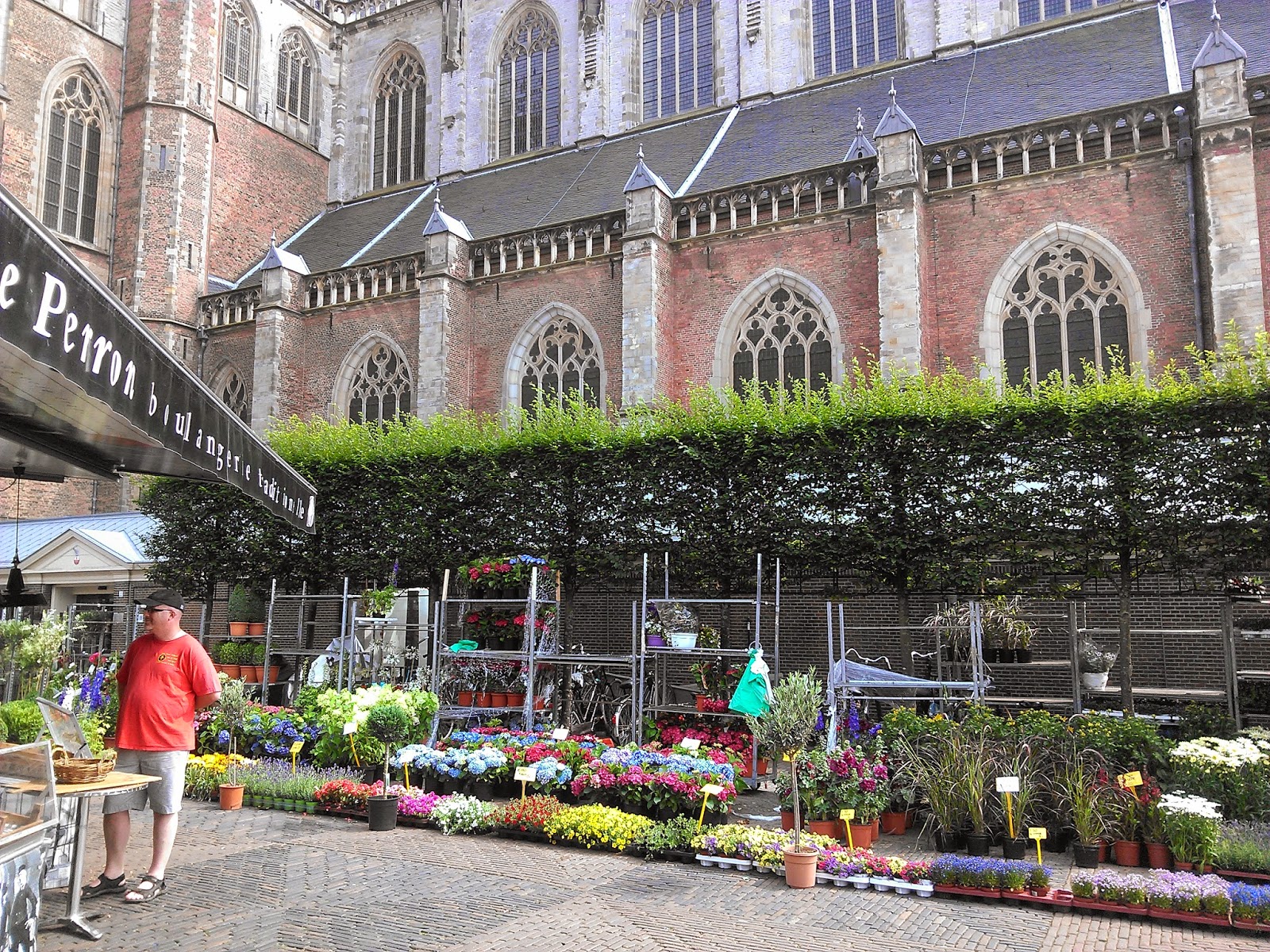
Mid-July - Vacation - Amsterdam, Netherlands
A long time ago, when I was a relatively new teacher, a veteran gave me some great advice. He said it was every teacher's responsibility to do something different during the summer, to become a more well-rounded person and therefore a better teacher. Professional growth is important, summer jobs are important, but a one-dimensional teacher is not doing his or her students any good.

My wife and I enjoy travel, especially in Europe, and for the first time in a few years, we had the time and money this summer to take a European vacation. We chose Amsterdam, because it was one of the big cities we had never visited. While others may try to fit in many locations on a two-week trip, we like to stay local and get to know one or two areas well. We rented an apartment and stayed in Amsterdam except for a couple of quick day-trips to other nearby cities (Haarlem and Zaandam).

We got to experience the FIFA World Cup finals in one of the countries involved. Unfortunately, since the Netherlands' team had lost to Argentina in the semi-finals, they were only playing in the third-place game, which almost no one in Amsterdam cared about. There were a few isolated fireworks after the victory, but most of the city responded with a very clear "meh".

We were greeted with a strong thunderstorm the first night we were there. Since we live in California, we thought this was great fun! Not so much fun was trying to figure out how the windows closed at 3:00 am in an unfamiliar apartment. A few days later it got sunny and hot. The locals we talked to expressed how much they loved the sunny weather; we wished it would get cool and rain again!

Our friends who live in Berlin came to visit us in Amsterdam for a weekend. It was interesting to hear their perspective on how Amsterdam had changed over the years, and how it compared to many of their other favorite cities.

I have already written about our experience using Google+ for photos during our trip. Another conversation I've had with people is about email: "to check or not to check". Do you completely cut off during your vacation, and never look at emails or tweets or other electronic communication that might remind you of work? Or do you stay plugged in and try to keep up? It seems like everyone has their own rationalization for their preferred strategy; here's mine. We had wi-fi in our apartment, and brought our Chromebook along with us, so we could stay in contact with family and friends. I also used that to stay up with emails and other messages, because (a) I wanted to make sure I was aware if there were any true emergencies that popped up, and (b) I didn't want to be overwhelmed with hundreds of emails when I got back. I did NOT immediately respond, or spend as much time with email as I would have at home. But I did set aside an hour or so on two occasions to send quick replies, save emails that I would need later, and delete emails I didn't need. Some people argue that you need to completely disconnect in order to relax on vacation. For me, I was more relaxed knowing that I was keeping on top of my inbox.

End of July - Google Teacher Academy - Mountain View, California
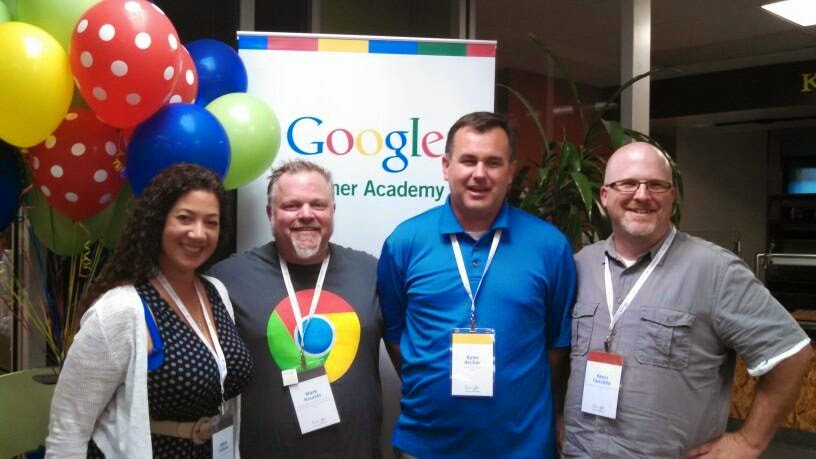
The last of my travels for the summer was to the Googleplex in Mountain View, not too far from San Jose. Google's Education division partners with CUE to put on Google Teacher Academies (GTAs). These are two-day workshops in which teachers work with each other and with Google employees ("Googlers") on all kinds of education topics. The sessions are productive and fun, but they are only held a few times a year, in places all over the world, and are limited to 50-60 teachers at a time. This means they are highly competitive to get in; I had applied twice before and was not accepted before finally getting in to this GTA.

L to R: Adina Sullivan (San Marcos), Mark Rounds (San Diego
Unified), Ryan Archer (San Marcos), and yours truly
Even better, several colleagues and friends, including three from San Diego, also got accepted to this GTA. Despite my surprise that many of them were not already Google Certified Teachers (GCTs), it was great to know that I would already be familiar with a dozen or so participants, leaving fewer than 50 names and faces to learn! That became much easier, though, because the photons had barely left the acceptance emails before a G+ community had been established and online introductions were being passed around. Our group started working together as a team months before ever meeting in person.

In front of the Google Fairchild 1 building, on Fairchild Drive.
The content of the sessions was secondary to the relationships and networks that we built among the group. Still, I did come away with some thoughts about specific tools. I think Google Maps and Maps Engine may be the most under-appreciated app in education. I am pretty familiar with the basics of YouTube, but learned more about channels and settings, which will make it easier for me to share with teachers and students. Googlers told us about the development process, features, and plans for Classroom and for Play for Education, both of which seem to be game-changers for the use of hardware and software in education, in our district anyway. Last but not least, Google Art Project has expanded and is now known as Google Cultural Institute; it includes amazing resources about historical events and world wonders as well as art museums.

One of the requirements of GCTs is that we share what we have learned with other teachers. That's already my job in my district, and I'm signed up to present at three conferences this fall, at minimum, so no problems there. We also are required to put together an action plan that outlines a project we'd like to undertake. The seed for my particular project has been sitting in my brain for a while but started to germinate this summer. I'd like to develop a badge system for teachers' professional learning, taking some of the concepts of micro-credentials and some from gamification, to motivate and reward teachers' everyday accomplishments. I'm still developing the idea; I'm sure you'll read more about it in this blog in the coming months.


Wednesday, May 21, 2014

Starting a District Twitter Chat - #SDUHSDchat

Escondido has one. Poway has one. It's time for San Dieguito to have our own Twitter chat!

Our district has many teachers using Twitter to build a professional learning network (PLN) and to learn about resources that can help them in the classroom. We have even more teachers who are interested but are unsure about how to get started. One of the goals of our new #SDUHSDchat is to help those teachers learn about how to use Twitter for professional learning in a supportive and controlled environment.

A Twitter chat is nothing more than an agreement by a group of people to be on Twitter at a particular time. A moderator will post questions related to the chat's topic; participants can then answer those questions, pose other questions, reply to others, and have discussions. To make it easy to find all the tweets for the chat in one place, everyone agrees to use the same hashtag, or label, for their tweets. We'll use #SDUHSDchat as our hashtag, meaning that label should be in every tweet for the chat.

We're going to schedule three chats before the end of the school year, each on Tuesday nights from 8:00 to 8:30. Here are our topics for each:

  • May 27 - Using Twitter for Good
  • June 3 - Changes in Your Class Next Year
  • June 10 - Summer Plans
Our team of moderators includes Michelle Anderson (@mathmama), math teacher at La Costa Canyon High School; Lori Meyer (@meyerteacher), English teacher at Carmel Valley Middle School; Bjorn Paige (@bjornpaige), current AP at La Costa Canyon and future Principal at Diegueno Middle School; and yours truly (@kfairchild6).

To read these chats, you don't even need a Twitter account; you just need to go to twitter.com/#SDUHSDchat and you'll be able to see what others are writing. In order to participate, you need to sign up for an account at twitter.com. It's free and easy to do, and you'll thank yourself later on. If you have an account but need a little help with how things work, take a look at this great website: Mom, This is How Twitter Works. If you're an advanced user, consider using a Twitter client with columns, such as Tweetdeck on a computer or Plume on Android.

Many people think of Twitter as social media, for frivolous use only. If that's what you find, then you are following the wrong people. I have found Twitter to be the single best way to keep me in contact with colleagues around the world and to learn about resources and ideas that are useful in my job. People smarter than I have described Twitter as a huge flowing river of professional learning, that you can approach with a spoon or with a bucket. It's any-time, any-place, any-pace professional learning. If you have any questions about getting started with Twitter, please let me know!

Sunday, May 18, 2014

Emergency Twitter

On Saturday, a day after we returned home from being evacuated because of the San Marcos wildfire, many of our neighbors were still not back from wherever they went. There is no damage on our street or in our neighborhood, but the blackened hillsides and pervasive smell of smoke remind us of what happened. During the two days that we stayed with friends (along with our two dogs and bird), we continually searched for news of what was happening with "our" fire, as well as around the rest of the county. What I realized is that during this emergency, I got most of my news from Twitter.

Tweets from news organizations and reporters provided updates more quickly than their television broadcasts did. Cal-Fire, the City of San Marcos, Ready San Diego, 2-1-1 San Diego, the County of San Diego, and other official agencies posted information on Twitter as fast or faster than on their websites. Perhaps most importantly, news and information were crowdsourced to hundreds of amateur photographers and reporters, the people who live in the area and were being evacuated. These first-hand witnesses became so important to news-gathering that news stations requested on-air that people tweet their pictures and stories to them.

On Wednesday the 14th, I had been at Carmel Valley Middle School meeting with a teacher. As I was returning to the office driving north on I-5, I saw a dense plume of black smoke and began trying to guess where it was. On returning to my office, I turned on NBC7's live feed on their website, and learned that the smoke I saw was from the Carlsbad fire, and that it was not currently threatening my own neighborhood or school district. I kept that website open and monitored the news throughout the day. In another window, I opened Tweetdeck and created a column for the hashtag #CarlsbadFire, where I got more information, especially from the school district employees and official accounts that I follow. That's where I learned that Carlsbad Unified had sent home non-essential employees from their district office, that two elementary schools had been successfully evacuated, and that La Costa Canyon High School was going to be used as an emergency shelter. I noticed that there were other fires in the county, but the vast majority of my attention was on the Carlsbad fire.

About 3:15, I closed up shop and headed home. In the car, I turned on 600 KOGO for news updates. At that point in the afternoon, there really wasn't much new information. I made my final U-turn before arriving at my own street, turning to face east, about 3:45, and that was when I saw the smoke (and more alarmingly, large flames) on the hillside above CSUSM, about a mile from our house. It was obvious that the fire had just started. I parked and went inside to tell my wife, and we both went out on the street to see the smoke plume, with many of our neighbors. As I stood in the street, I pulled out my phone and took a picture. My immediate thought was to put it on Twitter to let everyone know that there was a new fire in the county:

At just about the same time, I got a Twitter direct message from a colleague in the San Marcos school district, telling me about the fire and that it was near my house. (I found out later that this colleague and another were trying to let me know but they didn't have my cell number, so the best way they came up with to contact me quickly was through Twitter.) I also got a number of texts and emails from people who knew where I lived and had heard about this fire, so I was continually looking at my phone.

Back inside, we turned on the TV to see if we could get more information, but NBC7 was not yet mentioning the San Marcos fire. We started to gather stuff in case we had to evacuate. Meanwhile, my initial tweet had been retweeted by a couple of news organizations including Channel 8, so I started to get requests for more information. People I don't know tweeted me questions: Is it near San Elijo Hills? Which way is it moving? How close is it to CSUSM? I tried to answer these questions to the best of my ability, but quickly. One teacher in the district sent me an email saying that she had seen my tweet on CBS8 and asking for more info. (At first I thought she had been on Twitter and seen the retweet, so I was confused why she would email me. On re-reading her message, I wonder if she saw it on CBS8 television. I'll have to ask her.)

While I was gathering important materials and checking my phone for messages, I saw this tweet:

OK, I thought, time to go. As we got our dogs and bird and stuff into our two cars, I let our neighbors know that the evacuation order had been issued, in case they hadn't seen it. One of our neighbors, an older woman who lives with her brother, came and asked me if the order was official. She wanted me to go talk to her brother, who didn't believe the order and thought she was just over-reacting. He told her that if it was a real evacuation, sheriff's deputies would come knock on everyone's doors and drive around with loudspeakers. I told him that I saw the evacuation notice from the City of San Marcos official Twitter account, that with all the fires in the county that day there was not enough manpower to go around door to door, and that my wife and I were leaving. Looking back, what I could have told him was that Twitter is the official loudspeaker now (or at least one of them).

As we got to our friends' house and got our animals settled, we began looking for more information. They had the TV on, but I was looking at Twitter on my phone. I use Plume on my Android phone and tablet, so I can create multiple columns. I started one for #sanmarcosfire and another one for @sanmarcoscity, to get official notifications. One thing I noticed was the fluidity of names: the fire was initially called "the San Marcos fire", then "Washingtonia fire", then "Cocos fire". (The last two are the names of streets near the fire's origin.) As a consequence, the hashtags changed as well, from #sanmarcosfire to #washingtoniafire to #cocosfire. Looking for information on Twitter meant using all of these tags, since not everyone switched to the most current hashtag immediately. (I have not figured out in Plume whether I can create a column that would show two or more hashtags; e.g. #sanmarcosfire OR #cocosfire.)

Throughout our evacuation, I relied on Twitter for my initial information. Through tweets, I found out about the scheduled news conferences, which we turned on the TV for, but which rarely gave any new information. At one point, a celebrity with 3.3 million followers tweeted something like "pray for San Diego" and included all of the fire hashtags. The enormous number of retweets from those 3.3 million followers crowded out the actual information in the #cocosfire hashtag. I had to set up a "mute filter" in Plume, but the only way I could find to mute all the retweets was to filter on the actual text of the original tweet. It worked, but was cumbersome. I searched Plume for a way to exclude retweets in a column, but I did not find it.

As Thursday turned into Friday, and it became obvious that the fire was moving away from our neighborhood, we began to become impatient with the continued mandatory evacuation. We could not figure out why we were not being allowed back in. I saw an attempted explanation, which began a discussion:


You can see the amount of guesswork and frustration going into trying to understand the continued evacuation. Other people contributed to the discussion in this hashtag, as we waited for official word from the city. What we got was not particularly helpful.
The City of San Marcos did a good job using Twitter as an official loudspeaker, giving out information more quickly than they would have been able to otherwise. They used the fire hashtags, which made it easier for people to find their announcements, and they should be lauded for that. What they did not do well, however, was use Twitter as a two-way means of communication. Pleas for information or estimates, or even acknowledgement of reading residents' tweets, went unheeded. Simply replying to tweets, even if no information was forthcoming, would have helped calm down most people who were just trying to find out when they might be able to go home. In looking at the @sanmarcoscity tweets, the first reply to an individual that I can find came at 6:23 pm on Saturday the 17th. That's long after most people were back in their homes.

Friday afternoon, the first indication that our evacuation might be lifted came from a tweet from someone who said they saw the sheriff's deputies removing the roadblock at Rancho Santa Fe and San Elijo Hills Dr. After a few minutes of high expectations, we finally got the official tweet from the city with a revised map, meaning that we could go home. Lots of others were still evacuated, but many people could go home. It was a great relief, and news came through Twitter, like most of my news had for the previous few days.

The last big firestorm in our area was in October of 2007. My wife was in Boston for work at that time, but I was in contact with her and with our friends through my cell phone. I didn't have a smart phone then, just a flip phone. I don't think I even had SMS on that phone, or if I did, I didn't know how to use it. Twitter had just been invented the year before, and few people even knew about it. This time around, Twitter was an indispensable resource for communication.

UPDATE 27 May

The teacher who emailed me about seeing my tweet on CBS8 tells her story:
Yes, we did end up having to evacuate because we are living in SM. I was at school testing kids and I had the channel 8 news up on my computer in the background while the kids were testing. I was watching the La Costa fire because I was afraid some of the kids were going to get pulled and wanted to make sure the winds didn't shift and affect us. Then I saw your retweet on the side. There were a bunch of people talking about different fires, but I didn't really believe them because...you know...hysteria. But then I saw your name! You were a much more credible source. Since I was testing, I didn't want to pull out my phone and I thought it would be easier just to email. When I heard back, I contacted my husband (who was at home) and he started to gather up the cats and some of our things and then pick up my grandma (who lives a couple streets away). Your tweet gave us the heads up we needed to get prepared without being totally rushed! Thanks!!!

Saturday, March 15, 2014

Who is Tom Bock, and Why Does He Keep Following Me?

So I have a doppelganger on Twitter. A twitterganger, if you will.

It started last week, when I was looking at Tweetdeck one evening. I saw a post with our district's tech hashtag #SDUHSDtech from one Tom Bock. Now, I've wanted to get teachers in our district using that hashtag for conversations, but so far I'm just about the only one who uses it. So it is a rarity when I see a post in that column that I didn't write. Furthermore, I don't know anyone named Tom Bock. I decided to click on their profile to see who it was. Here's what I saw:
The internal monologue in my head went something like this, as I read:
  • Teacher on Special Assignment: OK, cool, someone else who is a ToSA...
  • (Technology and Learning): What a coincidence, that's my title, too!
  • for the San Dieguito... WAIT A MINUTE! WHAT?
This account had copied my bio, but not my current bio. This is one from a few months ago, before I made some changes. It got stranger as I started investigating. Starting on February 28, this account re-posted my tweets nearly verbatim, 3 or 4 per day. I say "nearly" verbatim, because it stripped out the @ before Twitter usernames, so the people I had written to would not see these tweets. Here are some examples:


This was weird. There's nothing special about the tweets the account chose to re-post. I couldn't find any pattern. There's no distinguishing information in the account's profile. I tried a Google Image search on the profile picture but did not find a match, so I can't tell where the photo came from.

I presumed this was a "bot", not someone who was manually re-typing my posts. This was confirmed in my head after I started tweeting about the account itself:
Several of my Twitter friends recommended that I report the account for impersonation. One linked to Kathy Cassidy's blog post about her twitter imposter; I considered that my situation was not as bad as hers. After all, they didn't use my name, my photo, or my URL in their profile. On further consideration, though, I decided that it was impersonation. First of all, this account was representing itself as coming from my school district. I work hard to represent my district professionally on Twitter, and don't want someone else behaving inappropriately and having that reflect on my district. Secondly, I would like to think that I have a positive presence myself; I try to contribute as much to my PLN as I get from them. Some of the re-posts from "Tom Bock" got replies from people who follow me, and they followed "Tom Bock", in good faith. I don't want anyone to mislead my followers, especially with my own words. Third, there's the "annoying-little-brother-following-you-around-repeating-everything-you-say" factor. Finally, while 140-character tweets are not exactly grand treatises, plagiarism is plagiarism: dammit, I wrote those, and you stole them!

So I used Twitter's process for reporting an impersonating account. As part of that, I had to send in a picture of my driver's license to prove who I am. Since the account is not using my name, I also had to send in a picture of my district ID, to prove that I work for the district. It was a little bit of a pain, but not too bad.

However, Twitter does not agree with me:
According to Twitter, this behavior is perfectly fine. I can block "Tom Bock", but that won't prevent the bot from seeing and copying my tweets. Or I can protect my profile, which negates most of the benefit of having a PLN on a social media site.

That's where it stands now. As of today, "Tom Bock" hasn't posted anything since Tuesday. Maybe the bot got tired. Maybe it's just storing up my tweets. Or maybe whoever created the bot realized that I'm aware of what it's doing. (I did re-tweet once, on accident, using the accounts' twitter handle. I tried to avoid that, but slipped once. Maybe that's what it takes to get it to stop? Just guessing.)

I've spent some time trying to figure out why someone would do this, and the only thing I can come up with is that it is to build an account with seemingly real tweets that can then be sold to someone else. I've never understood the "Buy 10000 followers immediately" offers, but obviously some people do that. I suppose someone could charge more for "real" accounts with dozens of tweets rather than obviously newly-created accounts. But I'm just guessing.

This is a minor issue; an annoyance, nothing worse. But it has certainly made me think about how fragile our online reputations are. We teach our students about creating positive digital footprints (or digital tattoos), but much of it is out of our hands, unfortunately. And I think it gives me just a little bit more insight into people who are seriously stalked, harassed, or threatened on Twitter (or other networks) and feel like there's nothing they can do about it.

In any case, I think all we can do now is to block "TomBock3" and report the account for spam. If you haven't done that already, I would appreciate it.

P.S. I'm a child of the 80's, and one of my favorite bands from then is Timbuk3. If this were a real person named Tom Bock, and they used "Tombok3" as their Twitter handle, that would be genius!


UPDATE 3/16: Looks like I spoke too soon. "Tom Bock" copied six more of my tweets last night, so I guess the bot isn't finished. All six of the tweets were posted at 2:53 am. I'm using a new Twitter app on my Android tablet (Plume), and when I look at the followers of "Tom Bock", it shows the most recent tweet for them. Fully half of those "followers" also posted their most recent tweet at 2:53 am. How long is it before Twitter is nothing more than bots following other bots?

Tuesday, December 11, 2012

Monday, October 22, 2012

Personal Learning Networks - Book Review

Richardson and Mancabelli have made a powerful case that having a personal learning network (PLN) is crucial for people to be successful in the 21st century.  For that reason, students need to be taught how to develop, cultivate, and use a PLN.  As teachers and administrators, we can't help our students do that unless we practice it and model it ourselves.  This has some profound implications for what classroom practice should look like in a connected and always-on world.

They define a personal learning network as a "set of connections to people and resources both offline and online who enrich our learning." (page 2).  While these have existed throughout history, the emergence and proliferation of electronic connections makes global networks possible and even easy.  For students, this can shift the locus of learning outside of the classroom.  Why should they listen to their physics teacher, when they can connect with physics experts throughout the world?
[T]he explosion of learning outside of school walls is too powerful to ignore.... [T]he idea of schooling as we currently know it will struggle to remain relevant in a networked world....  [S]chools need to plug into this vibrant worldwide network of learning to stay relevant and to prepare our children for a vastly different learning landscape.  That means schools will need to embrace a form of learning that is fundamentally different from the one they have known. (page 3)
The authors then develop their argument that personal learning networks are the key to this transition.  They describe the positive effects of PLNs, how to become a networked learner, how to implement a networked classroom, and how to become a networked school.  It is the first part of the book that I found most useful and that I suspect most teachers will as well.  Understanding why and how to develop PLNs are the first steps toward helping students use them effectively.

Chapter 2 (Becoming a Networked Learner) includes instructions for joining Twitter, Diigo, Google Reader, Blogger, and Facebook.  Each of these sections describes the tool, some of the advantages and disadvantages of it, and how to jump right in and start.  I currently use all of these except Facebook for professional learning, and feel like they have certainly helped me make my transition from science teacher to educational technology teacher.  These kind of connections can help any teacher, but are especially relevant for the isolated teacher: someone who doesn't have any colleagues teaching the same class at their own site.

The companion website has links to the resources listed in the book.  I highly recommend this book (especially the first half) to anyone still wondering how technological development is affecting learning processes.  If any of you would like to borrow this thin volume, please let me know.

Friday, August 10, 2012

Twitter hashtag for SDUHSD

If you'd like to get started using Twitter (and I recommend it), here's an easy way to do it.  Sign up at www.twitter.com, and enter "#SDUHSDtech" in the search box.  We'll use that hashtag for discussion specific to our district this year.  You don't have to follow anyone if you don't want, but you can follow me (@kfairchild6) if you do.  This is a simple way to get your feet wet, and once you're used to Twitter, you can explore more.  Remember, though, that you should consider everything you share as public: there's nothing private on Twitter.

Wednesday, July 25, 2012

What I have learned about Twitter


When I got my new position as Teacher on Special Assignment back in May, I figured I needed to learn more about social and professional networks, beyond using Facebook to keep in touch with friends.  I joined a number of networks, including Twitter. It took me longer than I thought it would to get the hang of Twitter, but I feel like I'm gradually making better and better use of the system.  Some examples:
  • What I thought: You can't say anything worthwhile in only 140 characters.
  • What I learned: Most professionals are sharing links to articles, not making lengthy arguments.

  • What I thought: I have to follow a lot of people in order to read anything.
  • What I learned: Hashtags for subjects (#EdTech, #scichat, etc.) allow me to read a discussion whether or not I follow individuals.

  • What I thought: I have to read everything in my feed from oldest to newest.
  • What I learned: Are you kidding?  It can't be done.  Pick and choose and don't worry about missing something.

  • What I thought: Twitter has a website, so I should use that to read.
  • What I learned: There's a separate program called TweetDeck that allows you to have separate columns and makes reading a lot easier.

Internet tools such as Twitter have allowed me to develop a professional learning network in only a few weeks, which has introduced me to a huge number of tools and resources that I can learn from as well as share with my teachers this year.  For example, according to nearly everyone on #EdTech this afternoon, Apple is now getting into the LMS game with iTunes U (http://www.apple.com/education/itunes-u/).