Showing posts with label Literacy. Show all posts

Friday, September 19, 2014

To "E" or Not To "E" - Teens and Reading

Adrienne St. George is our district's Media Center Specialist. She contributes this guest post on teens and reading, although she would like to state for the record that she had nothing to do with the terrible headline of this post. You can contact her at adrienne.stgeorge@sduhsd.net.


Teens are reading more than ever!!! No, that is not a line from a science fiction story; that is a very current consensus by reputable research groups and interested critics.

Teens' reading efforts match/exceed adult levels:
16 – 29 age groups actually read MORE than the 30+ age group. A lot of this is due to reading that is necessary for school but personal reading numbers are equal for both age groups which is awesome news! Teens/young adults will read on any device available while the 30+ age group prefers an e-reader or print.

Teens/adults use libraries differently than adults. Statistics show that they actually use libraries MORE than adults. However, they use them for book recommendations, getting help with apps and digital questions, e-books, online information, and online classes. The general consensus of teens/young adults is that all library services should be online. When asked about the future of public libraries, teens and young adults don’t think that libraries, as a physical entity, will have a strong impact on their community. They DO, however, want to be able to access all of the public library digital resources.

When asked about a preference in reading print or a digital format, youngsters (0 -8) tend to lean to print, as that is what they are familiar with when parents read to them. Parents are in full support of print for the 0 – 8 age groups for reading because that is what they grew up with and are familiar with. From age 10 on, most parents are not as concerned with the version of a book; they just want their kids to read! Some of the reasons given by parents for the huge rise in digital reading in teens since 2011:
  • I read e-books and that’s what my kids see. If I am modeling this behavior, I need to allow them the same option.
  • E-books are available right away. Being able to satisfy an interest in a book right away is important.
  • There is a wide selection of e-books.
  • E-readers are affordable, some are even free.
  • E-books are easy for long travel, on the way to school or in bed.
  • If an e-book will get my kids to read, then they can read an e-book!
The bottom line is that reading, as a whole, is on the rise. Statistics show that e-books have been instrumental in saving the publishing industry... just like Burton pretty much saved the skiing industry with the very “nasty” snowboard! (Sorry I can’t back that up officially but who cares as long as there is a mountain covered with sierra cement to ride?!)  Many say that e-books have contributed to the resurrection of reading, but who cares as long as everyone is enjoying a book in whatever format they prefer?


Book Revenues are Up, by Kelsey McKinney on June 27, 2014, Vox Media
Children, Teens and Reading, Common Sense Media Research Brief, 2014
E-books vs Print: What Parents Need to Know, by Jenny Deam, Parent and Child/Scholastic, 2014
E-book Revolution: We’re Reading More than Ever!, by Husna Haq, Christian Science Monitor, April, 2012
Zero to Eight, Children’s Media Use in America 2013, Common Sense Media Research

Pew Reports:
A Snapshot of Reading in America in 2013
Digital Age Reading, Writing, Research
E-reading Rises in 2014
The Rise of E-reading

Monday, September 1, 2014

Of Poor Cartooning, Obvious Jokes, and Back-to-School Assignments

Joe Heller, Green Bay Press-Gazette, 2009
Jeff Parker, Fort Myers News-Press, 2012
Rick McKee, The Augusta Chronicle, 2014
And these are just the ones I found with a few minutes of googling. OK, we know that there are only a few editorial cartoons in existence, that get rehashed over and over. (Surely there's an "Editorial Cartoon Tropes" website, like "TV Tropes", but I'm not going to search for it because I might find it.) And, yes, I get that single-panel cartoons have to include signifiers like the apple on the desk, old-school (literally) chalkboard, and ruler in the school-marmish teacher's hand, so that (older?) readers know the scene is set in a classroom. And I understand that part of the "humor" in these is the contrast between the "old" teachers and the "young" students these days with their phones and their technology and their twittagramsnapbookchatspaces and whatnot. But really? Do we have to do this same "joke" over and over again? (With a little bit more searching, I bet you could find the same cartoon for 2010, and 2011, and 2013. I'll actually give Joe Heller a little credit: in 2009, Twitter was not nearly the big deal and obvious cultural reference it became later.)

You know what would be a great assignment for the first week of school? Having students share what they posted on Twitter during the summer. Or on Instagram. Or have them create a Glogster of their photos and texts and tweets. Or contribute to a class blog about their experiences. Or compiling their Vines into an annotated YouTube video.

You know what would not be a great assignment for the first week of school, and would only indicate that you are out of touch with modern schools, children, technology, and culture in general, and that you can only imagine a school system that looks exactly like it did when you went to school decades ago? Asking students to put down their devices, ignore the writing and reflection they did during summer when school is out, have them get out a nice, sharp #2 pencil, and handwrite (maybe in cursive) a boilerplate 3-paragraph essay about "What I Did This Summer".

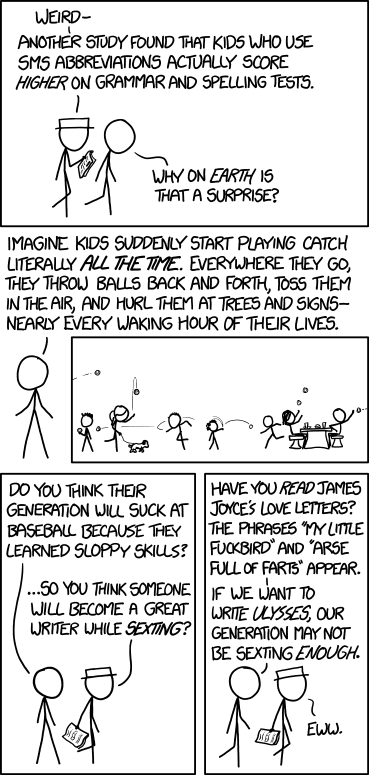
"But," you might object, "kids didn't do real writing during the summer. Texting and tweeting and tumblring aren't valuable as academic writing." Maybe not. But they were doing it. They were communicating with each other. Writing practice is writing practice. The inestimable Randall Munroe of XKCD, as usual, has said it better than most:


Friday, August 9, 2013

Common Core Literacy Standards for Science and Technical Subjects, Summarized

Through a colleague on Twitter, I came across this great post from Mark Clements about how he had taken the Social Science CCSS Literacy standards, summarized them, and re-grouped them, in an attempt to make them easier to digest for teachers who may not be very familiar with Common Core.  Since I will be working with Science teachers later this month, to introduce the CCSS Literacy standards for Science and Technical Subjects, I was inspired to follow his example with the Science standards.  Here's what I came up with.

First, the Reading standards, summarized:


Next, the Writing standards, similarly shortened:


From these restatements, I was able to group the standards into four categories:


And here's how I grouped the standards into those categories:


As with Mark Clements' Social Science summary, I present this in the spirit of beginning discussion; I'm sure someone else will be able to summarize and organize these better than I did.  If you'd like to make edits, here is a link to a Word document with these tables.